
Madison County Bench Warrants Explained
Think of a Madison County bench warrant as paperwork attached to a case that already exists. Skip a hearing, miss a payment, or ignore an order, and the judge can act on the spot. Where the case lives depends on the charge: county misdemeanors, county traffic, and felony proceedings run through District Court, while city traffic, ordinance, and city misdemeanor matters belong to the municipal court that set the date. Labels can mislead you. The sheriff's inmate roster carries descriptions like “BENCH WARRANT-FELONY,” “CAPIAS WARRANT,” and “FAILURE TO APPEAR TRAFFIC,” but those are booking notes, not a full Madison County bench warrant register. A capias simply orders that a person be brought before the court. Its real effect shows only in the case file.
Missed Madison County Bench Warrant Dates
Missing a court date in Madison County does not trigger one fixed response. The judge might note the absence, issue a bench warrant, adjust bond, or set a fresh requirement instead. To find the setting that was missed, the Alabama court docket service is a decent starting point, and it warns plainly that some cases never show up. So treat the Just One Look docket search as a lead rather than proof of warrant status. The clerk is the better source. Call the court listed on the citation or notice, with the full name, case or citation number, and hearing date in hand. Ask two things: did the judge issue a bench warrant, and what step clears it. One caution: a new date on the docket does not erase old process on its own.
How Madison County Bench Warrants Are Issued
In Madison County, the judge works from the file already on the bench. Once a required appearance or condition goes unmet, the court signs an order telling law enforcement to bring the person in. That bench warrant stays with the issuing court until it is served, recalled, quashed, or otherwise closed. Recall means the court pulls the warrant back. Quash means the court sets the process aside entirely. There is a second path, too. Alabama Rule of Criminal Procedure 3.1 permits a writ of arrest after someone fails to appear on a summons, and that route differs from a new probable-cause arrest warrant. Only the issuing court can say which order exists and whether bond or an appearance has been set, so that call comes first.
Madison County Bench Warrant Labels
The official inmate roster answers one narrow question: who is in custody. Its current and released filters describe booking status, nothing more, and neither promises that every warrant in Madison County appears there or that each listed warrant is still open. Entries can include booking number, intake time, release time, charge description, bond amount, holds, and age. A bench-warrant label alone rarely tells the whole case story or names the issuing court, so verify with the clerk.
- FTA
- Failure to appear for a required court event.
- Capias
- Process directing that a person be brought to court.
- Recall
- The issuing court withdraws its warrant.
- Bond forfeiture
- A court consequence that may follow a missed required appearance.
Madison County Bench Warrants Compared
A bench warrant and an arrest warrant both can put a person in custody in Madison County, but they begin differently. The bench warrant grows out of a missed duty in a case already open. An arrest warrant follows a sworn probable-cause process for an alleged offense. That distinction decides where you confirm the record and what happens next.
| Feature | Bench Warrant | Arrest Warrant |
|---|---|---|
| Trigger | Missed appearance or court duty | Probable cause of an offense |
| Who issues it | Judge in the existing case | Judge or magistrate after sworn facts |
| Record route | Issuing clerk or municipal court | Issuing court and Sheriff's Annex |
| Next step | Reset, appearance, recall, bond, or counsel | Confirmation, surrender, bond, and court |
Huntsville Bench Warrant Channels
Huntsville Municipal Court runs its own misdemeanor, ordinance, and traffic cases at 815 Wheeler Avenue. The official warrant and bail page posts 256-427-7861 for normal-hours warrant interviews and 256-427-7817 for after-hours bail, with the main court line at 256-427-7810. These city channels are separate from Madison County District Court and the Circuit Clerk, so ask which court set the missed event, whether an appearance is required, and where bond must be posted. Huntsville allows cash in certified funds, a professional bond, or an Alabama-real-estate property bond, subject to city rules.
Resolving a Madison County Bench Warrant
Fixing a Madison County bench warrant depends on the issuing court, the case, bond status, and any other hold. Paying alone does not guarantee a recall. Confirm with the clerk first, then ask what the judge requires.
- Confirm the warrant and issuing court using the case notice, clerk, or municipal court.
- Ask whether the case calls for a reset, surrender, bond, appearance, payment, or motion.
- Consult counsel when the case is contested, serious, sealed, or linked to another hold.
- After acting, obtain confirmation that the warrant was recalled or otherwise closed.
Caution: Do not assume a payment or new date lifted the warrant. Confirm the judge's action with the issuing clerk.
Municipal Bench Warrant Routes
Some bench warrants never touch county court at all. New Hope names its municipal court clerk as warrant magistrate, and the New Hope court page lists 5484 Main Drive and 256-723-9214. Triana Town Court handles traffic, parking, and ordinance cases through a clerk-magistrate at 640 6th Street, reachable at 256-772-0151. Each city keeps its own file. Searching one county clerk cannot stand in for searching every city court, so call the municipal court whose citation, ordinance case, or hearing created the problem. The same logic covers Owens Cross Roads and Madison city. Jurisdiction comes first.
Finding the Madison County Warrant Court
County cases begin with the Madison County District/Circuit Clerk. Call the Criminal Division at 256-532-3386 or the Traffic Division at 256-532-3373. County warrant magistrates sit in Room 217 at 100 Northside Square. They handle misdemeanors charged outside city limits, county felonies, county traffic, and certain worthless-check complaints. City cases run differently. Huntsville, Madison, New Hope, Triana, and Owens Cross Roads each have their own municipal court. The formal records request covers only Madison County Circuit and District files, not federal, municipal, other-county, or out-of-state records. Mail it or hand-deliver it. Expect up to two weeks, and a search charge can apply even when nothing turns up.
The issuing court, not an online booking label, is the final source for Madison County bench warrant status.
Madison City Bench Warrant Checks
For a Madison County city warrant, the Madison Municipal Court page lists the schedule, the clerk, the warrant and bail contact, and the address.
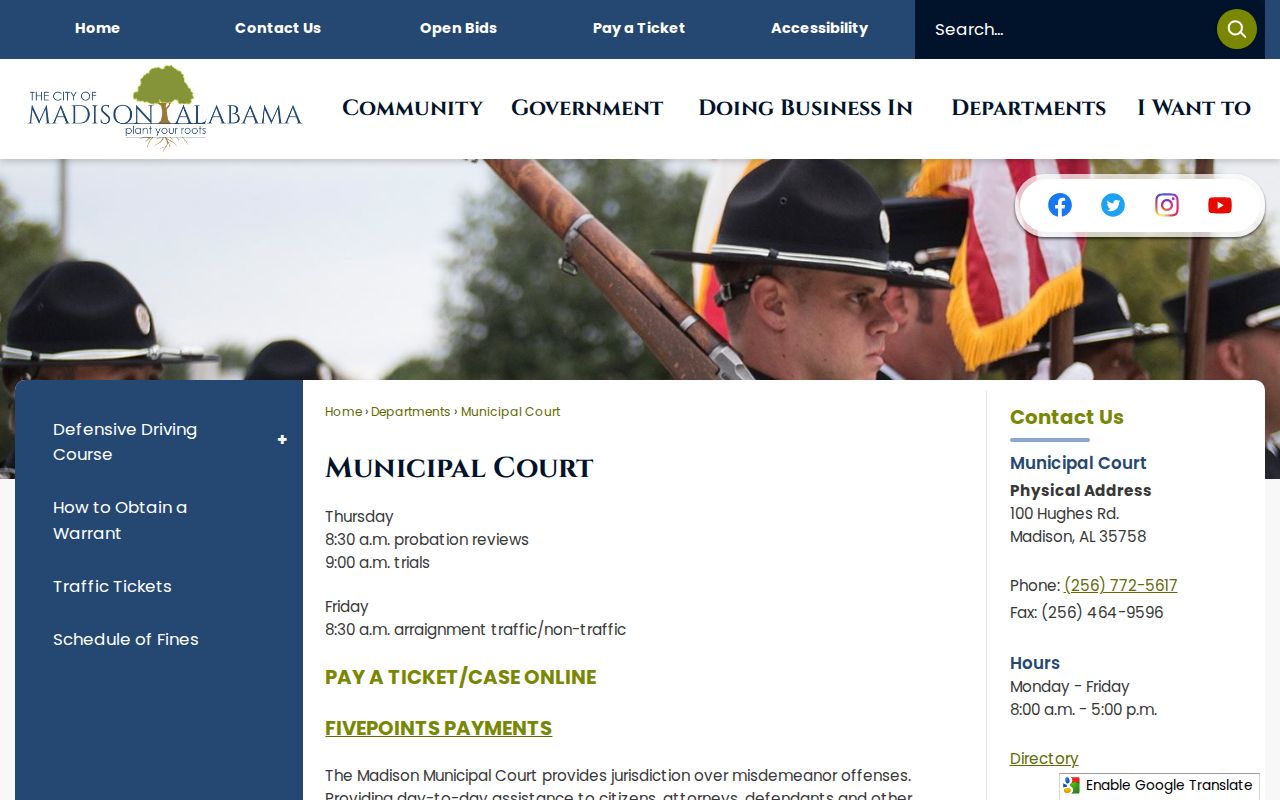
A municipal bench warrant stays with the court that issued it. In this part of Madison County, that means Madison Municipal Court at 100 Hughes Road. The main line is 256-772-5617. Warrant and probation questions go to 256-772-5657. Ask whether the missed court event produced a warrant, whether bond applies, and whether an appearance is required. Then confirm the judge has actually recalled the warrant. A payment entry, a bond receipt, or a new date proves nothing until the clerk verifies the recall order. For a cash or property bond, the city posts weekday office hours. A bonding company runs on its own schedule. Online cash bond may also be offered. Those options never control the warrant. The municipal judge and clerk still set the status, so if a second hold appears, ask which Madison County agency placed it and whether another appearance is required. Keep every receipt, bond paper, and reset notice. Call back once the record should have updated, since a finished payment step is not the same as a signed recall.