
Madison County Arrest Warrants Explained
An arrest warrant gives a Madison County officer legal authority to take someone into custody. It does not begin with the arrest, though. Police bring a sworn deposition and investigation material before a neutral warrant magistrate. That magistrate weighs probable cause, the point at which enough sworn facts support a reasonable belief that an offense occurred and that the accused committed it. A police report alone never gets there. For a felony complaint, an agency must investigate first, and the victim later returns to complete a deposition and testify under oath. If the facts hold up, the judicial officer signs the order. Madison County charges no fee to apply. Bond and court costs can still follow later.
Madison County Arrest Warrant Workflow
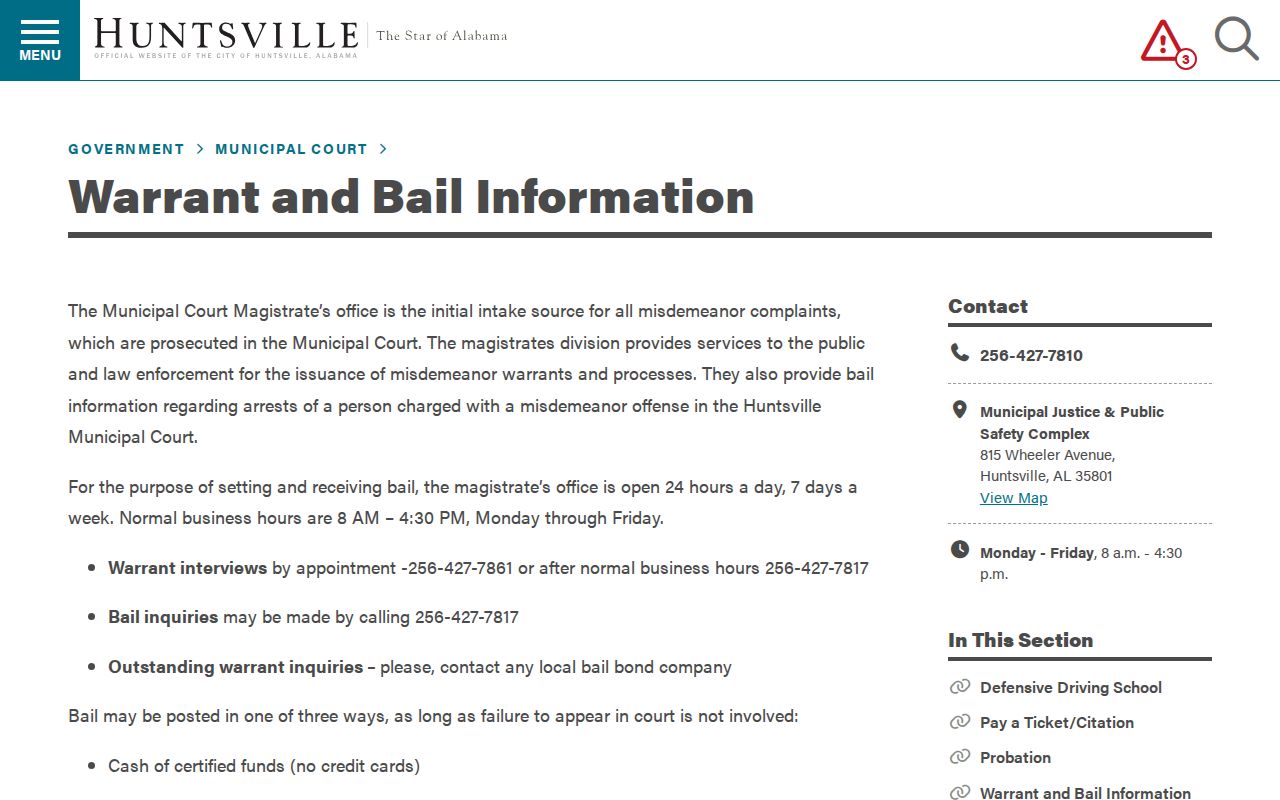
The county's Warrant Magistrates page lays out the sequence. A felony starts with an agency investigation. The victim returns after 1:00 p.m. the next day, completes a deposition, and testifies under oath while the magistrate independently weighs probable cause. For city matters, an official Huntsville warrant source shows the municipal route, which differs from the county track.
Deposition and charge sheets can carry sensitive identifiers. They explain how a Madison County warrant issued, but they are not public name lists.
Unserved Madison County Arrest Warrants
Madison County keeps its arrest warrants out of public view until they are served, so no countywide arrest-warrant search exists anywhere online. The sheriff's Most Wanted page is a hand-picked list, not an index. The inmate roster tracks custody, not warrants. Both fall short of a full warrant lookup. If you suspect an active warrant, go in person to the Sheriff's Annex at 705 Wheeler Avenue, or call non-emergency dispatch at 256-722-7181, a 24-hour line. The contact page lists the Warrants/Extraditions number as a fax, so use it only for documents.
No online match does not establish that no Madison County arrest warrant exists.
Madison County Arrest Warrant Jurisdiction
Where you look depends on the charge. County magistrates handle Madison County felonies, county traffic matters, misdemeanors outside city limits, and qualifying worthless-check complaints. Huntsville, Madison, New Hope, Triana, and Owens Cross Roads municipal courts keep their own traffic, ordinance, and misdemeanor records. The Circuit Clerk's formal request route covers Madison County Circuit and District files only. It excludes municipal, federal, out-of-county, and out-of-state records. Start with the court tied to the alleged event.
Madison County Arrest Warrant Bonds
Confirm bond terms for a Madison County case with the office handling it or with the holding facility. The county jail line is 256-519-4800. Huntsville publishes certified cash, professional bond, and qualifying Alabama real-estate property-bond routes. The county sheriff, though, does not process property bonds. Those rules belong to two distinct systems, so ask where bond must be posted and whether another hold exists. A roster amount never guarantees release. Only the current court order controls.
Madison County Arrest Warrant Returns
In Madison County, service and return follow Alabama Rule of Criminal Procedure 3.3. An Alabama law-enforcement officer serves the warrant, records what occurred, and returns it to the named clerk. That return becomes part of the official court history. A current-custody roster filter does not show that every warrant is active. A release time is not an expiration date. The clerk or issuing court confirms present status.
Inside a Madison County Arrest Warrant
Alabama Rule of Criminal Procedure 3.2 sets what a warrant must contain. The issuing judge or magistrate signs it. It names the defendant or gives a description good enough to identify the person. It also states the alleged offense, commands an arrest, and may set release terms. Local charge and deposition forms add a warrant number. No single public number format exists in Madison County. Names alone can match more than one person. A case number, a birth date shared privately with the clerk, the issuing court, and the service history together separate records. Identifiers in the application file fall under court privacy rules and are not for republication.
| Warrant Number | ARREST WARRANT NUMBER, when the court releases it |
|---|---|
| Named Subject | Name or identifying description in the judicial order |
| Charge / Offense | The offense supported by the probable-cause finding |
| Issuing Judge / Court | The judge or neutral magistrate and the court file |
| Bond / Bail Set | Release amount or conditions, if stated |
| Date Issued | Date the judicial officer signed the process |
Serving Arrest Warrants in Madison County
Alabama Rule of Criminal Procedure 3.3 lets any Alabama law-enforcement officer execute an arrest warrant. The officer records the execution and returns the process to the named clerk. Madison County sources name no single constable or city-marshal route for every case. Which agency serves a warrant depends on that warrant and its jurisdiction. Booking, a judicial appearance, bond review, or another hold may follow service. The Madison County Sheriff's inmate roster shows booking and release facts, charges, bond, and holds. It is not the warrant itself. Ask the issuing court for the judicial record. The detention office answers current custody questions.
Comparing Arrest, Summons, and Bench Warrants
Rule 3.1 allows an arrest warrant or a summons after indictment or a finding of probable cause. A summons just orders the person to appear. Ignoring one can bring a writ of arrest. A bench warrant usually grows from a missed duty inside an existing Madison County case. These differences shape the safest response.
| Feature | Arrest Warrant | Summons | Bench Warrant |
|---|---|---|---|
| What It Orders | Arrest | Appearance | Custody for a missed obligation |
| Basis | Probable cause | Charge and formal notice | Failure to appear or comply |
| Who Issues It | Judge or magistrate | Court | Judge in the existing case |
| How to Respond | Confirm, seek counsel, plan surrender and bond | Appear as directed | Contact the issuing court about recall or appearance |
If There's an Arrest Warrant for You
Start with the court that issued the paperwork. Know which court it is and what kind of process you face before you do anything else. A county-level matter points to the Sheriff's Annex in Madison County. Call ahead and ask the practical questions. What identification should you bring? How does voluntary surrender work there? Ask about booking, bond, the first court date, and whether any other hold exists. If the case started inside a city, skip the county channel entirely and use that municipal court's warrant and bail process instead. Get a lawyer if the identity is disputed, the allegation is a felony, the file may be sealed, or another jurisdiction is involved. The Circuit Clerk cannot give legal advice. From there, resolution usually comes through surrender, bond, an appearance, or a motion asking the issuing court to recall or quash its order. Split your questions between the two offices. The court can tell you the charge, the issuing authority, the case number, and the filed return. The detention office handles custody, booking, bond processing, and holds. Bond may come as cash, property, or through a professional bondsman, but Madison County and Huntsville publish different rules on this. Confirm the requirements with the office that will actually take the money before you arrange any funds. Once the first appearance is over, hold on to your paperwork. Keep the bond receipt, the release documents, and every later court notice. Verify the case sits on the right docket. A served warrant does not close the criminal case. It only records the arrest authority and its service, while the charge moves forward in court. And if a roster lists the wrong name, do not try to fix it through a third party. Bring solid documents to the issuing clerk or to counsel and raise the identity problem there.
Important: Speak with a lawyer before surrender when the charge, identity, bond, or another hold is uncertain.